Full-Vocabulary, Identity-Preserving Target
Every unit of teacher probability is routed by bytes or parked in an explicit residual — exact on 99%+ of positions, mass conserved.
BPM




Abstract
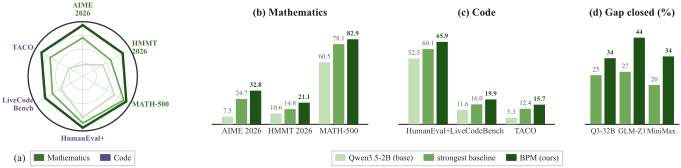
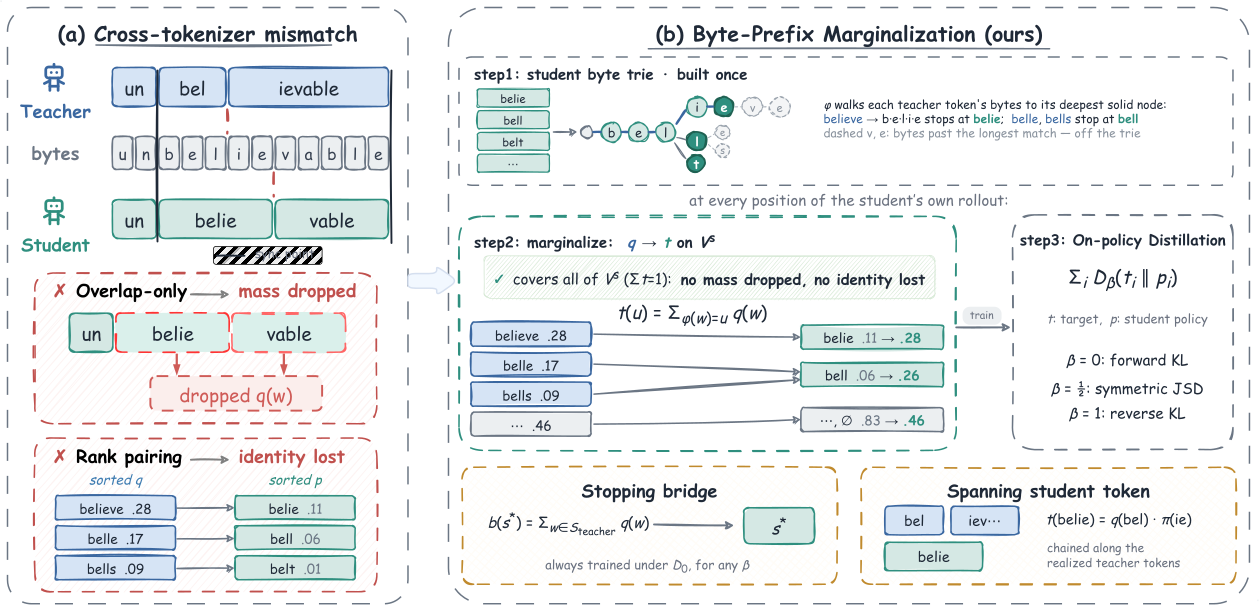
Open-weight language models from different families exhibit complementary capabilities, motivating their consolidation into a compact student through on-policy distillation (OPD). However, full-vocabulary OPD typically assumes a shared tokenizer, while existing cross-tokenizer methods may discard teacher probability mass or assign it to student tokens with unrelated content. We introduce Byte-Prefix Marginalization (BPM), which re-expresses the teacher’s next-token distribution over the student vocabulary in a shared byte space. Specifically, BPM assigns each teacher token’s probability to the longest student token whose byte representation is a prefix of the teacher token’s bytes, aggregates mass mapped to the same student token, and places otherwise unmatched mass in an explicit residual category. This produces a vocabulary-complete, byte-aligned, and mass-preserving target for dense OPD. The target exactly recovers the teacher-induced byte-prefix marginal when the relevant prefix does not span multiple teacher tokens (a condition satisfied at more than 99% of training positions) and uses a mass-preserving, chain-factorized lower bound otherwise. Across Qwen3-32B, GLM-Z1-9B-0414, and MiniMax-M2.7 as teachers, BPM consistently outperforms current cross-tokenizer methods on six mathematics and programming benchmarks, improving six-benchmark avg@8 by 3.7–6.6 points over the strongest baselines.
Contributions
Every unit of teacher probability is routed by bytes or parked in an explicit residual — exact on 99%+ of positions, mass conserved.
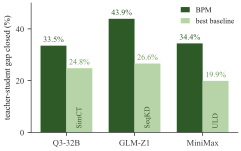
Beats overlap, rank, hybrid, and sequence-level baselines on all three teacher pairs — including contests held after every teacher's cutoff.
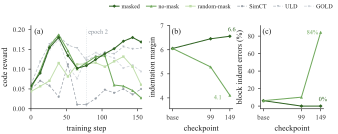
Whitespace-only code rows transfer pure segmentation noise (49%→9% pass collapse); a precomputed row mask removes it.
Method
The student samples under its own template and decode settings — supervision lands where it acts.
The same bytes, re-rendered in the teacher's template, scored into full-vocabulary distributions.
Teacher mass routes to the longest student token prefixing its bytes; the rest to an explicit residual.
One β axis spans FKL / JSD / RKL against the projected target; a whitespace-row mask guards code.
Pipeline
Method Insight
Two tokenizers read the same bytes and cut them differently — in exactly four ways. Follow one strip of text through all four; hover a case to isolate it.
Benchmark Results
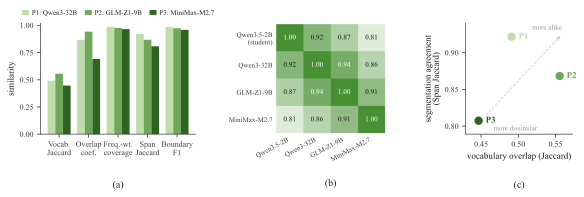
Student: Qwen3.5-2B (thinking mode). Cells are six-benchmark averages, avg@8 / pass@8 (%). P1 = Qwen3-32B (same family), P2 = GLM-Z1-9B, P3 = MiniMax-M2.7 (least overlap); span Jaccard 0.92 / 0.87 / 0.81. Subscripts denote BPM's margin over each pair's best baseline.
| Method | P1 · Qwen3-32B | P2 · GLM-Z1-9B | P3 · MiniMax-M2.7 | |||
|---|---|---|---|---|---|---|
| avg@8 | pass@8 | avg@8 | pass@8 | avg@8 | pass@8 | |
| Teacher | 67.4% | 80.3% | 63.0% | 76.7% | 65.4% | 80.5% |
| Base Student | 24.7% | 40.5% | 24.7% | 40.5% | 24.7% | 40.5% |
| SimCT | 35.3% | 52.4% | 26.3% | 45.0% | 25.0% | 37.7% |
| ULD | 25.1% | 41.4% | 34.2% | 50.0% | 32.8% | 48.0% |
| GOLD | 29.7% | 47.3% | 33.0% | 51.9% | 27.5% | 42.5% |
| SeqKD | 33.8% | 52.4% | 34.9% | 53.9% | 26.4% | 45.5% |
| BPM (Ours) | 39.0%+3.7 | 60.9%+8.5 | 41.5%+6.6 | 59.4%+5.5 | 38.7%+5.9 | 57.1%+9.1 |
Ablations
Ablation 01 · Divergence
| Variant | Math (3) | Code (3) | All (6) | |||
|---|---|---|---|---|---|---|
| avg@8 | pass@8 | avg@8 | pass@8 | avg@8 | pass@8 | |
| P1 · Qwen3-32B (teacher) | 70.9 | 82.5 | 64.0 | 78.1 | 67.4 | 80.3 |
| BPM-FKL | 47.7 | 69.7 | 30.3 | 52.1 | 39.0 | 60.9 |
| BPM-JSD | 46.1 | 65.9 | 25.5 | 49.7 | 35.8 | 57.8 |
| BPM-RKL | 47.0 | 67.0 | 26.6 | 49.6 | 36.8 | 58.3 |
| P2 · GLM-Z1-9B (teacher) | 63.0 | 78.6 | 63.0 | 74.7 | 63.0 | 76.7 |
| BPM-FKL | 47.1 | 65.0 | 35.9 | 53.8 | 41.5 | 59.4 |
| BPM-JSD | 43.1 | 60.7 | 34.2 | 50.8 | 38.6 | 55.8 |
| BPM-RKL | 42.5 | 59.4 | 31.1 | 49.9 | 36.8 | 54.6 |
| P3 · MiniMax-M2.7 (teacher) | 72.5 | 87.1 | 58.2 | 73.9 | 65.4 | 80.5 |
| BPM-FKL | 41.9 | 60.6 | 35.4 | 53.6 | 38.7 | 57.1 |
| BPM-JSD | 43.7 | 59.1 | 23.8 | 48.8 | 33.8 | 54.0 |
| BPM-RKL† | 38.5 | 59.8 | 18.6 | 41.7 | 28.5 | 50.7 |
Percent. Three-way spread: 3.2 (P1), 4.7 (P2), 10.2 (P3). FKL is β=0, JSD β=½, RKL β=1 at skew 0.1. Tinted rows are teachers. † Pre-collapse peak.
Ablation 02 · Data
| GLM-Z1-9B pair | FKL | JSD | RKL | Avg. |
|---|---|---|---|---|
| Original mix (20k) | ||||
| avg@8 | 41.5 | 38.6 | 36.8 | 39.0 |
| pass@8 | 59.4 | 55.8 | 54.6 | 56.6 |
| Harder-math mix (20k) | ||||
| avg@8 | 39.4−2.1 | 38.9+0.3 | 37.4+0.6 | 38.6−0.4 |
| pass@8 | 57.1−2.3 | 57.0+1.2 | 55.1+0.5 | 56.4−0.2 |
| Expanded corpus (35.5k) | ||||
| avg@8 | 40.7−0.8 | 38.9+0.3 | 37.6+0.8 | 39.1+0.1 |
| pass@8 | 58.4−1.0 | 58.3+2.5 | 53.9−0.7 | 56.9+0.3 |
Six-benchmark percent. Subscripts give the change from the original mix.
Ablation 03 · Whitespace mask
Citation
@misc{wang2026bpm,
  title={Cross-Tokenizer On-Policy Distillation via Byte-Prefix Marginalization},
  author={Hao Wang and Kun Yuan and Wenlin Zhong and Minglei Zhang and Han Xiao and Ming Sun and Honggang Qi},
  year={2026},
  archivePrefix={arXiv},
  primaryClass={cs.LG},
  eprint={2607.22334},
}